Random thoughts and pictures…

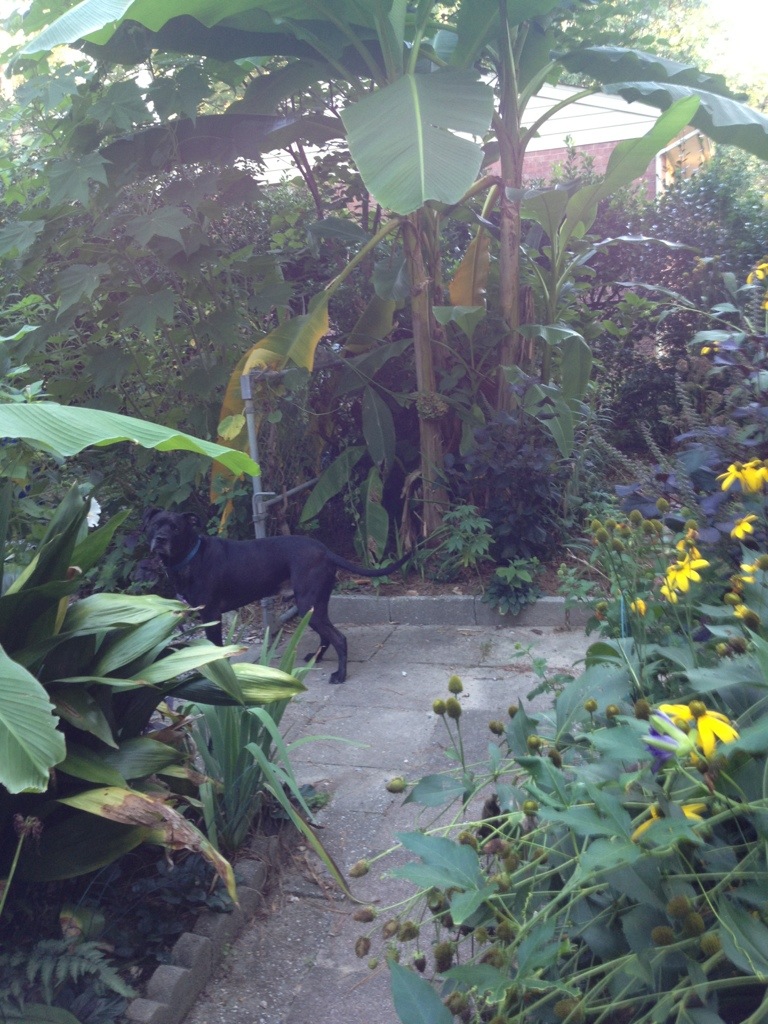
We have received plenty of rain this summer. Everything has grown so lush. The view up the drive of the garden gate is very impressive!

20130805-133930.jpg

We walked part of the Raleigh Greenway I like to call Capital Swamp because it has a long boardwalk over a marsh and pond. There were many turtles and young ducks.

20130805-134135.jpg

It’s very amazing this area is so close to downtown!

20130805-134226.jpg

Parts of the greenway are also wooded.

20130805-134331.jpg

And there were several Great Blue Herons today!

20130805-134424.jpg

Of course, we had to stop by India Mahal for lunch!

20130805-134541.jpg

Back in the garden the Bumble bees were enjoying the Rose-of-Sharons (Althea) which were coming into their blooming season.

20130805-134721.jpg

They come in shades of blue/purple, red/pink, and white, and either have red throats or plain throats. The seed prolifically so there are many volunteers!

20130805-135013.jpg

They can grown into large shrubs/small trees so I like to trim them back to about knee high every five years or so.

20130805-135251.jpg

Beautiful and easy!

22 Comments

Filed under Plants

Crape Myrtles and Southern Gardens

I grew up on the Southeast coast of North Carolina. The weather is humid and subtropical. The winters are very mild and the hot summer days are often followed by short rain storms. I did not realize how much the ocean breezes cooled the air until I moved about an hour-and-half inland to attend college. The summer air was so humid and thick you could cut it with a knife!

The good side, as a gardener, is I could grow so many tropical species down there! Now I am two-and-half hours from the coast and the winters are just a bit colder but not by much thanks to climate change.

Crepe Myrtles are a very popular tree or large shrub throughout the South. The flowers originally came in shades of red and pink but now there are whites and lavenders and purples. There are also a few sections with burgundy foliage, also.

NCSU has a very nice list of the cultivars with descriptions of flower color and growth habits:

http://www.ces.ncsu.edu/depts/hort/consumer/factsheets/trees-new/lagerstroemia_indica.html

A few photos for Crape Myrtles around Raleigh, North Carolina.

I call this color watermelon. These are in my neighborhood.

20130726-172920.jpg

A pink Crape Myrtle in Cameron Village Shopping Center.

20130726-173015.jpg

A young group of mixed colors near Cup-A-Joe.

20130726-173051.jpg

And a beautiful purple Crape Myrtle in front of The Reader’s Corner.

20130726-173119.jpg

This beautiful red one on Oberlin Road has a very nice shape.

20130726-173145.jpg

And a white one photographed late in the evening.

20130726-215135.jpg

Crape Myrtles need to only be pruned to removed crossed limbs or damaged or low hanging limbs. Some varieties have beautiful bark that can peel in beautiful strips which revel shades of red and brown.

Unfortunately, most landscape crews do not know how to prune this heavy blooming plant. They tend to prune crape myrtles as if they are herbaceous perennials.

This promotes an awful water- sprout type growth.

These are weak stems which may eventually split the main trunk where they are attached. This type of pruning creates a look of a pollarded tree. Its not attractive or healthy for any tree.

Just say NO and don’t.

No! No! No! If you are in doubt that your Crape Myrtles need to be pruned. Just don’t do it. They will look better with a more natural shape anyway.

This is a properly pruned crape myrtle.

20130728-095009.jpg

This pruning allows the a more natural shape to develope which allows the beautiful and colorful bark to be seen.

20130728-095157.jpg

🙂

18 Comments

Filed under General Gardening, Plants

Poached Eggs

When I purchased new cookware last Fall the set included an egg poacher. I have always liked the idea of poached eggs. It seems healthier than frying and easier to eat than a boiled egg. It’s very easy with a poacher.

The poacher sits on top of the pan of boiling water and is removable so the poached eggs are easy removed.

20130725-102509.jpg

Poached Eggs

1) Fill the saucepan with an inch or two of water.

2) Fit the egg cups in the poacher which has been cleaned. Grease the cups with a little butter so the eggs will slide out easily.

3) Crack the eggs into the cups. If you are not using all the cups fill the empty cups half way with water.

20130725-102353.jpg

4) Bring the water to a boil then turn down just a bit. Cook 2 to 4 minutes. Two minutes will produce a soft yoke while four minutes will produce a hard yoke.

20130725-102425.jpg

5) To remove the eggs, invert the cup onto a paper towel and tap the cup until the egg falls out.

Server with Hollandaise sauce or hot sauce, or the Southern condiment of choice – ketchup!

20130725-102453.jpg

Aren’t Gus’s legs cute?

20130725-102531.jpg

17 Comments

Filed under cooking, Food